High-End Office Suites Are Filling the Gap Between WeWork and a Trophy Lease
The flexible office market has grown into one of the most consequential segments of commercial real estate. The global flexible office market was valued at $45.24 billion in 2025 and is projected to grow to $51.99 billion in 2026, with projections reaching $194.75 billion by 2034 at a compound annual growth rate of nearly 18%. Cushman and Wakefield reports that 55% of global occupiers now use flexible office solutions, while 17% plan to increase usage, reflecting a shift from temporary solution to long-term real estate strategy for many organizations. That growth has been driven in large part by companies rethinking how much space they need, how long they want to commit to it, and what they expect the experience to feel like when they show up. The answer to that last question is increasingly: considerably better than what the first generation of coworking delivered.
WeWork’s cultural dominance over the flexible office category for the better part of a decade did something complicated to the market. It popularized short-term, fully serviced office space at a scale that made the concept mainstream, but it also associated flexible offices with a particular aesthetic and clientele that didn’t translate well to every professional context. The open bars, the communal tables, the hoodies, the ping pong tables. It was a compelling product for early-stage startups and freelancers. It was considerably less compelling for the managing partner of a boutique private equity firm trying to host an institutional investor. “We have been talking about flight to quality for a while in office,” said Adam Stark, founder of Stark Office Suites. “The shared office is going that way too.” The same dynamic reshaping demand in the traditional office market, where tenants are concentrating in the newest and most amenitized buildings at the expense of older commodity stock, is now playing out within the flexible office category itself.
Stark Office Suites has been operating in this space since 2004, long before WeWork made flexible offices a household name. The company operates a portfolio of fully serviced, turnkey office suites across New York’s most prominent business addresses, and earlier this year launched Excelsior by Stark Office Suites, a premium concept positioned explicitly at the top of the market. Excelsior currently operates at 717 Fifth Avenue and 825 Third Avenue, two of Manhattan’s most recognizable commercial addresses, offering private offices with high-end finishes, panoramic views, conference facilities, and a hospitality-grade service model. The positioning is deliberate and specific. As the Excelsior concept describes it, the space is designed for professionals whose achievements are established and whose workspace is expected to reflect that standing, an environment defined not only by its quality but by the caliber of those who occupy it.

The clients that this concept is designed for are a well-defined but underserved segment of the office market. “There is a subset in the office market of smaller tenants who want to be part of these trophy buildings but are not big enough to be able to get into them,” Stark said. “That is who we are trying to serve.” A three-person hedge fund, a boutique M&A advisory firm, a solo general counsel who has gone independent, a real estate attorney growing their practice, these are professionals for whom a traditional lease at a trophy office tower would be prohibitively expensive, but need more than a hotdesk at a shared workspace. The premium serviced suite market sits precisely in that gap, offering access to addresses and environments that those tenants couldn’t otherwise reach, without the long-term commitment and capital outlay of a conventional lease.
The landlord equation is equally important and equally specific. Trophy building owners have not always been enthusiastic about sharing their lobbies and elevators with the full demographic breadth of the flexible office market. “Landlords need to get comfortable about the kinds of people that are going to be in the building,” Stark said. “They don’t always want people in jeans and hoodies like you might see in a WeWork.” That concern is not aesthetic snobbery. It is a business calculation about the perception of the building and the experience of other tenants who signed long-term leases at premium rents partly because of the address’s exclusivity. A premium serviced office operator that serves financial professionals and lawyers maintains the social and professional tone of a trophy building in a way that a mass-market coworking operator does not. That alignment changes the landlord calculus considerably.
It did not change it overnight. Stark’s experience building landlord relationships over two decades illustrates how much the category has matured. “In 2004 when we started, we needed to provide two years of security deposit up front just to help the owners get over their worries about us as a tenant,” Stark said. “Now owners see our track record and visit our other spaces and they are much more willing to have us as long-term tenants.” That credibility compounds over time. An operator with a fifteen-year tenancy in a recognizable building, a stable customer base of financial and legal professionals, and a demonstrable track record of maintaining the quality of the space and the caliber of the occupants is a very different proposition from a first-time flexible office operator asking a landlord to take a leap of faith.
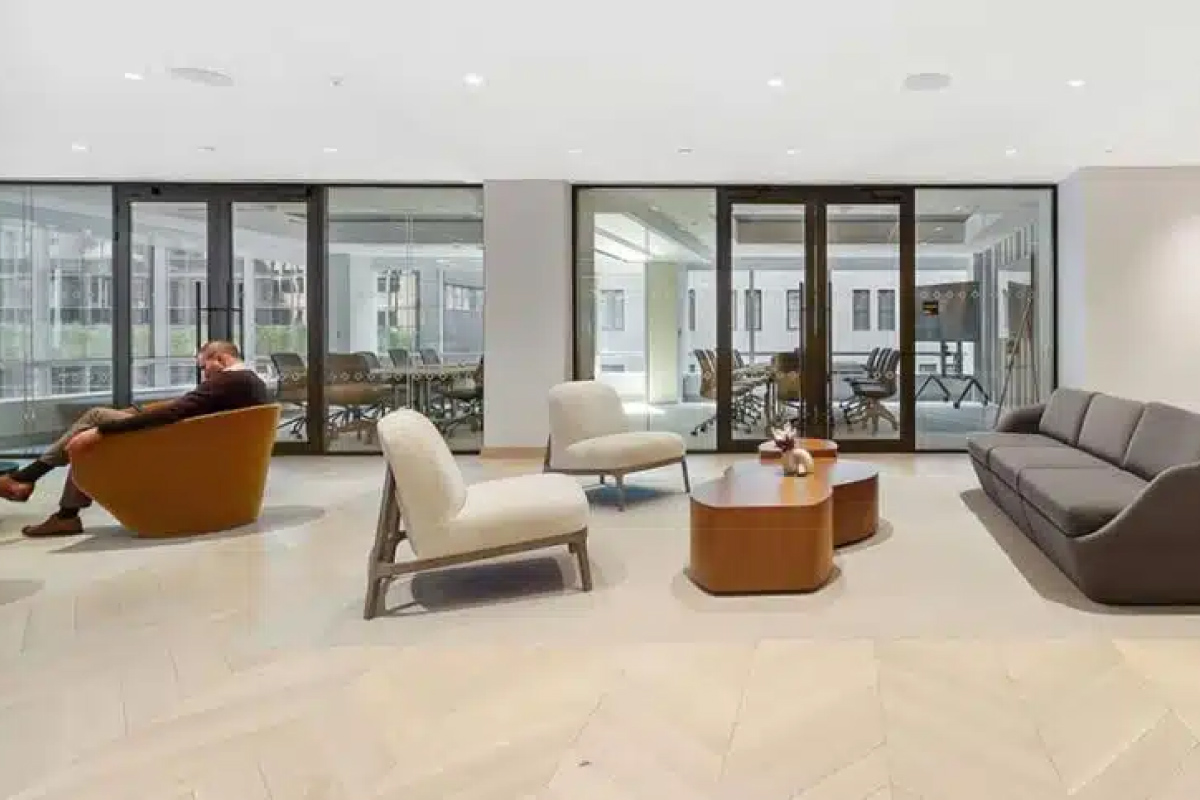
Site selection is where the product starts. “We want all of our spaces to have a great view,” Stark said, “because that is what you don’t get in many other shared workspaces.” That sounds like a feature, but it functions more like a filter. A great view in a Manhattan tower means a high floor, which means a premium building, which means the address and the building standard come with it automatically. From that foundation, the design and service model have to do the rest. The look and feel needs to be consistent with how a successful professional presents themselves to clients. The finishes, the furniture, the lighting, the reception, all of it needs to communicate that the person who works here has arrived rather than that they are still on the way. The amenity package needs to include the conference rooms, the hospitality services, and the administrative support that a growing professional services firm genuinely uses. And crucially, there need to be private areas, proper offices with closing doors and acoustic separation, because the clients this market serves are often handling sensitive conversations that cannot happen at a shared table.
The data suggests the market for exactly this kind of client is growing. The Banking, Financial Services, and Insurance sector has the highest coworking occupancy rate of any industry at 32.4%, and professional services represents the second highest occupancy rate in flexible office environments. The executive suite market specifically was valued at $10.5 billion in 2025 and is projected to reach $15.2 billion by 2034, growing at a compound annual growth rate of 4.8%. The North American flex office market as a whole is expected to nearly double from $14.9 billion in 2025 to $28.9 billion by 2030 as companies adopt asset-light strategies and shorter lease terms. The professional services firms, boutique investment managers, and independent advisors who represent the natural customer base for premium office suites are exactly the kinds of organizations that hybrid work dynamics and shorter lease preferences are pushing toward flexible solutions. They want the address. They want the service. They want the privacy. They want the flexibility. What they don’t want is to share a bathroom with a startup’s development team. The premium office suite market exists because those are not unreasonable things to want simultaneously, and building a product that delivers all of them is harder than it looks.
The post High-End Office Suites Are Filling the Gap Between WeWork and a Trophy Lease appeared first on Propmodo.