New global order: AI CEOs as heads of nation-states
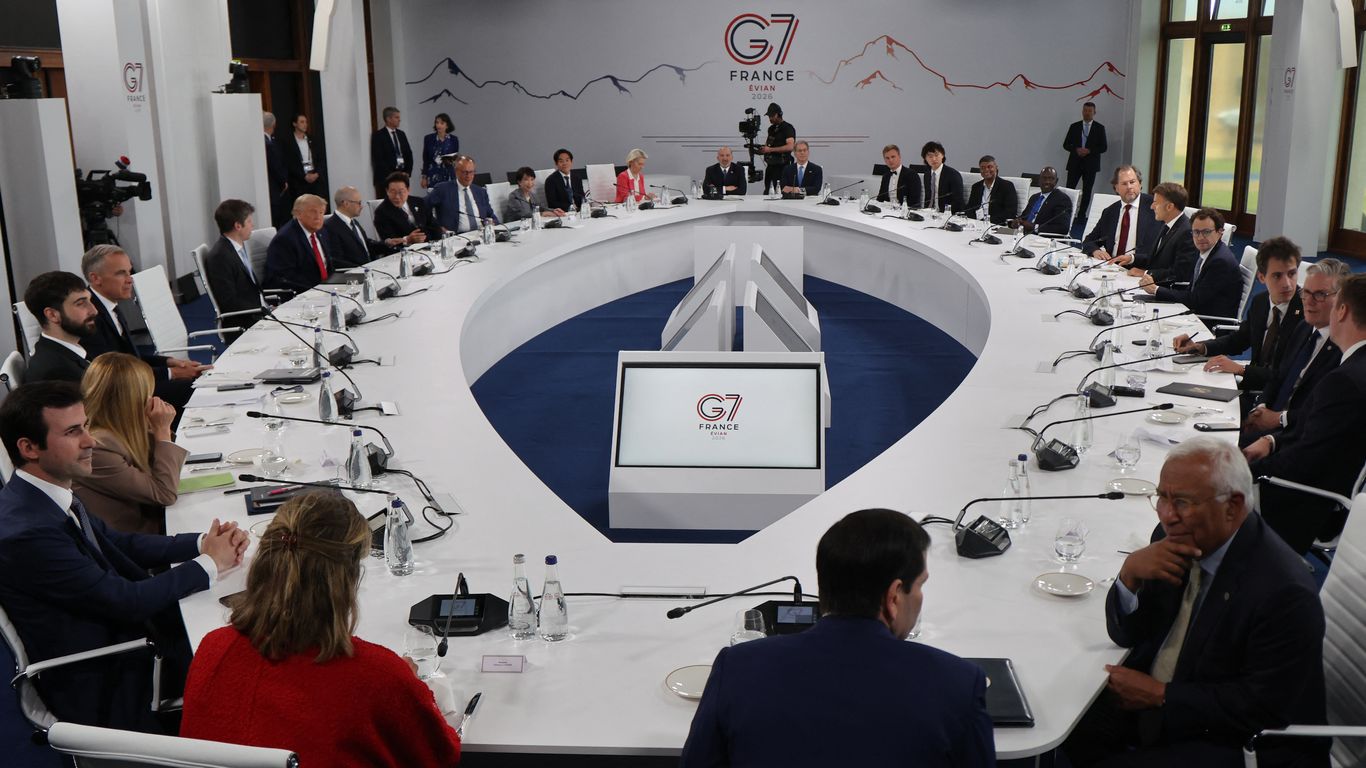
It was a historic, even jarring, scene that captures a once-unimaginable geopolitical ordering. The world’s most powerful heads of state gathered in the French Alps this week for the annual G7 summit, with the CEOs of America’s dominant AI companies seated and treated like heads of nation-states themselves.
Why it matters: This is the future many leaders and AI CEOs envision — heads of state and the masters of tech in constant discussion, and sometimes conflict, over who controls AI, its rules, and its application to governing and world security.
Think of Anthropic vs. Trump as merely a small test run of this dynamic, with governments battling private companies over their products’ threat to U.S. or global security.
- AI CEOs sat around the table with leaders of the world’s democracies, treated as peers. The companies, creating the world’s future economy and security infrastructure, are now the equivalent of nation-states.
In the photo above, President Trump (upper left above) is flanked by OpenAI CEO Altman at his right and Google DeepMind CEO Demis Hassabis, a Nobel laureate, on his left.
- The G7 host, French President Emmanuel Macron (upper right above), is flanked by Anthropic CEO Dario Amodei and Salesforce CEO Marc Benioff.
🕶️ Altman was swarmed on Wednesday as he entered the summit room in Évian-les-Bains for a working lunch with the heads of actual states, with ministers and cabinet members from around the world straining for a look.
- Altman held bilateral meetings — bilats, in diplomatic shorthand — with many of the heads of state. He heard again and again that the countries want the AI companies as dependable partners.
“Do not cede your responsibilities to AI labs like mine,” Altman said in closed-door remarks. He later added: “No single lab should be making the decisions.”
- Amodei, Altman and Meta chief AI officer Alexandr Wang each posed with Macron for bilat photos with the French flag behind them, in the chair typically occupied by a president, prime minister or chancellor.
- Also at the working lunch: Arthur Mensch, CEO of the French company Mistral AI, and heads of AI labs in Japan, Germany, Italy and the U.K.
The working lunch was closed to the press. But I’ve confirmed key remarks by each of the three AI titans. All three urged Western powers to work together to be sure democracies continue to dominate AI:
Amodei told the G7 leaders they must “resist the temptation to splinter” over the rollout of advanced AI tools.
- He was referring to democracies joining together as AI leaders versus authoritarian governments.
Altman called for “an international forum for discussion that establishes globally accepted standards for testing, provides expert and impartial analysis of capabilities and risks, and serves as a venue for cooperation among nations.”
- “[Once guardrails are in place] we must err toward human liberty,” he added. “We want everyone on Earth to benefit from this technology, and to figure out for themselves how to use it.”
- “We are an American company and will be governed by the laws of the United States. But we recognize and deeply appreciate the sovereignty of the democratic nations in this room.”
Hassabis, whose AI startup DeepMind was bought by Google in 2014, said: “[W]hen we look back at this time in 10, 20 years’ time, I think we’ll see that we’re standing in the foothills of the singularity. … I think this is nothing less than a new era in human history that’s coming up on the horizon.”
- “I think we need, and everyone’s been talking about, a standards body, a U.S.-led standards body, that ideally works with close cooperation with the international democratic community.”
- “We’re at one of the most critical moments in human history,” Hassabis added. “It’s immense potential. If we get this right, I think we can usher in the Golden Age of scientific discovery and progress.”
📱 Go deeper: Watch Marc Caputo’s post-G-7 interview with President Trump.