These new solid-state ACs promise a cool future. Scientists aren’t so sure.
After three years of record-breaking heat, this one is set to be yet another scorcher. Air-conditioning? Not going anywhere. The International Energy Agency projects that the number of AC units will triple by 2050.
That’s good for health—one Lancet study estimated that AC prevented nearly 200,000 premature deaths in 2019 alone—but bad for the planet. Artificial chill already accounts for 7% of global electricity use and 3% of greenhouse-gas emissions, and if improperly disposed of, the units can leak refrigerants with more global-warming potential than carbon dioxide.
Feeling the heat, a number of scientists and startups are hoping to amp up solid-state cooling, which is currently used at a small scale for things like mini fridges, EV batteries, and some high-end gaming computers. Traditional ACs transfer heat by using a compressor and a fan to circulate a refrigerant and turn it from liquid to gas.
Solid-state systems, on the other hand, move heat through conductive materials like gadolinium and bismuth telluride—which could theoretically cool spaces and surfaces with fewer messy side effects.
The catch is whether they can match the efficiency of conventional AC. “One of the key questions that remain is why are the solid-state coolers not as efficient as typical thermodynamic cycles?” says Pramod Reddy, a professor of mechanical engineering at the University of Michigan who studies heat transfer.
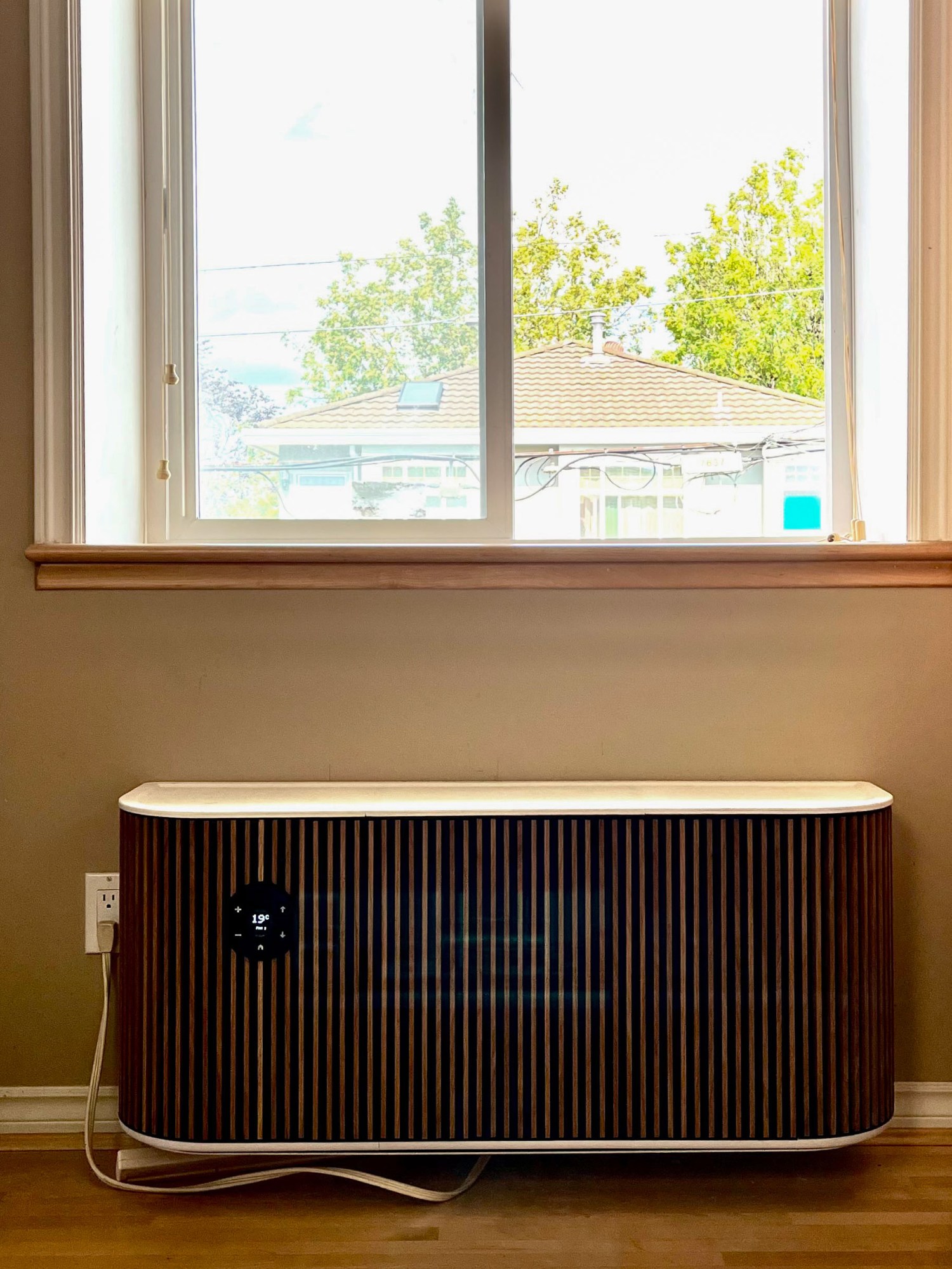
Research and pilot programs are underway to test a range of approaches. Brooklyn-based Mimic Systems uses thermoelectric cooling, which passes a current through semiconductive materials to shift heat from one side to another. Its room-scale climate control system is being piloted in an apartment in Vancouver.
The German company Magnotherm is set to test its system, which relies on a magnetocaloric setup that transfers heat by magnetizing and demagnetizing materials, in a chain of supermarkets. A team in Hong Kong has announced that its elastocaloric device, whose material heats and cools as it expands and contracts, can dip below 0 °C. And the UK’s Barocal is betting on barocaloric systems, which change temperature in response to shifts in pressure.
But experts, especially in thermoelectrics, have doubts about how well any solid-state scheme can compete. For most modern HVAC systems, the coefficient of performance (COP) is 3, explains Jeff Snyder, a professor at Northwestern University who studies electrical and thermal conductivity. That essentially means the system moves three units of heat for every unit of energy that goes into it.
Thermoelectrics in particular tend to have a much lower performance at high levels of temperature change, Snyder says, which means they’re best suited for niche uses such as cooling the back of a car seat.

Efficiency, however, isn’t everything, argues Lindsay Rasmussen, a manager at the Rocky Mountain Institute’s climate tech accelerator Third Derivative, which supports both Magnotherm and Mimic. In the US, most ACs currently in use employ a refrigerant called R410A, which has a global-warming potential more than 2,000 times that of carbon dioxide. Plus, their moving parts can make them less durable, especially compared with a solid-state model that’s less mechanically complex.
Still, a dearth of units makes it hard to answer the efficiency question. To understand how well alternatives work, says Rasmussen, researchers need to compare their long-term energy consumption with that of conventional models instead of simply looking at COP. Mimic claims, for example, that its room-scale model should match the draw of a typical AC unit over the course of a year. Elastocaloric and barocaloric systems also have promise, Rasmussen adds, but room-scale prototypes are probably two to three years away.
In the end, the likelihood that solid-state cooling could replace compressor-based AC is slim. But as the planet warms and places like India install tens of millions of new AC units over the next decade, supplanting even a small number could make a dent. “If [solid-state] could take over even a 5% market share,” Rasmussen says, “that is a really large potential impact.”
Sara Kiley Watson is a science journalist specializing in climate and sustainability. She’s based in The Hague.