


Why the Hotel and Residential Building Hybrid Is Having a Moment
The line between a hotel and a home has been blurring for years. Extended stay concepts, serviced apartments, and branded residences have all pushed in that direction, each finding an audience that wants something more permanent than a hotel visit but more curated than a standard apartment lease. The latest iteration of that convergence is more structurally ambitious than its predecessors. A new generation of developments is placing hotels and long-term rental residences inside the same building, sharing infrastructure, amenities, staffing, and brand identity in ways that produce something neither asset class could achieve independently. The numbers reflect growing conviction in the model. The number of branded residential projects worldwide has grown from 323 in 2015 to around 910 expected by the end of 2025, nearly tripling in a decade, with 837 new projects already contracted in the pipeline through 2032. Savills reports 19% growth in the sector in 2025 alone, with buyers paying an average 33% premium over comparable unbranded properties. A premium that durable and that consistent doesn’t reflect novelty. It reflects a shift in what a certain kind of resident thinks a home should feel like.
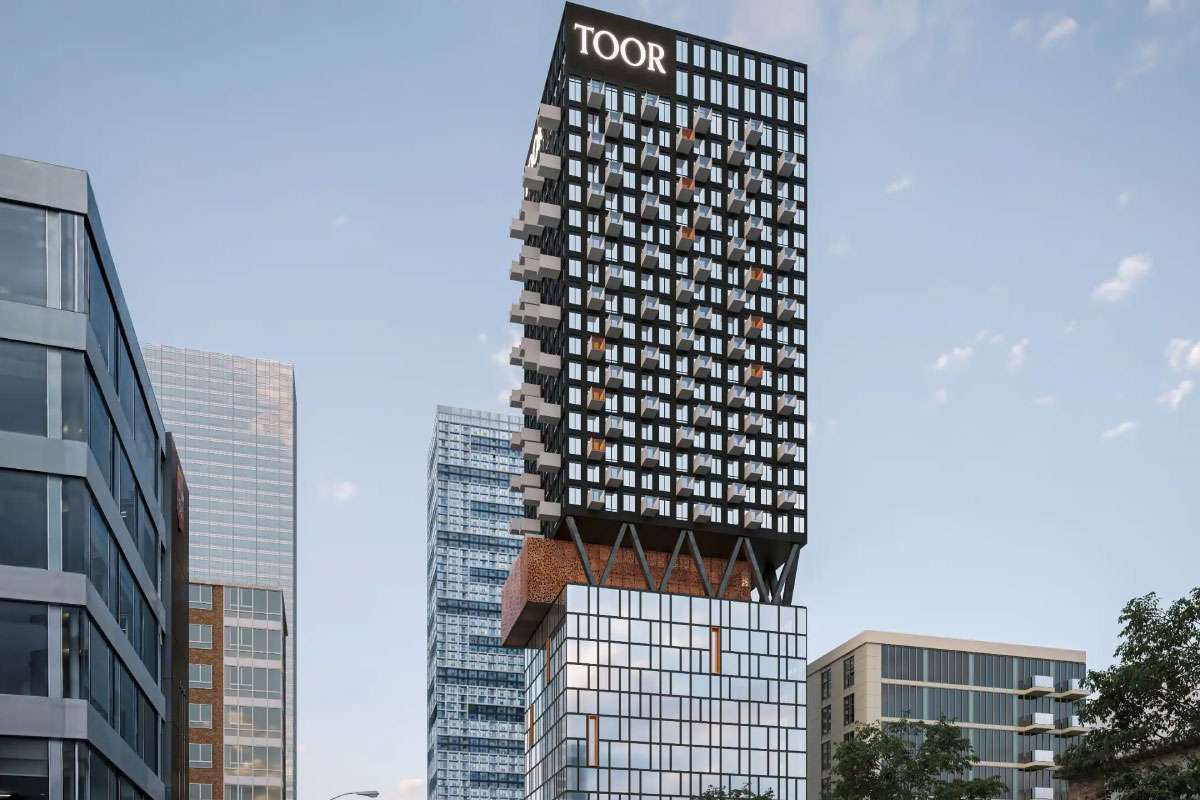
TOOR Hotel Toronto is a useful place to examine how that shift plays out in practice. Developed by Manga Hotel Group and designed by interior design and strategy firm Mackay Wong in partnership with Arcadis, the newly opened 32-story tower in Toronto’s Garden District brings together TOOR Hotel, operating as a JdV by Hyatt boutique property, and The 203 Residences, a private collection of rental apartments occupying the upper floors. The design draws from the nearby green spaces of Allan Gardens and Moss Park, positioning the building as a kind of modern greenhouse, layered textures, bold accents, and a palette that nods to historic conservatories while reading as unmistakably contemporary. The design is considered and the location is well chosen, but what makes the project worth paying attention to is something more structural. “This one is unique because it’s not just condos for sale,” said Gordon Mackay, Director of Strategy at Mackay Wong. “This is a rental apartment on top of a hotel.” Most branded residence programs sell units to individual buyers who own and occupy or rent them out independently. The 203 Residences are operated as a unified rental portfolio by the same ownership running the hotel below, which means a single entity is responsible for the experience of everyone in the building, from the guest checking in for a weekend to the resident who has lived there for three years.
That structure changes the business logic considerably. Hotel brands carry loyalty ecosystems, guest databases, and service reputations built over decades. When that equity extends to a residential product, it arrives with something a conventional apartment building has to spend years trying to manufacture. “The brand association gives the residential component a head start,” said Mansoor Kazerouni, Global Director of Architecture and Urbanism at Arcadis. “You’re not just leasing an apartment. You’re leasing into an identity that already means something to a specific kind of person.” A prospective resident who already trusts the Hyatt portfolio arrives predisposed in a way that no marketing campaign fully replicates. That translates into a faster leasing process, a more self-selecting resident base, and a price point supported by the totality of the experience rather than just the unit itself.

Shared amenities are where the model’s operational complexity becomes most visible, and where the design decisions carry the highest stakes. A pool, fitness center, restaurant, and event space serving both hotel guests and residents can achieve utilization levels that neither population would sustain on its own, and the quality of what ownership can justify building scales accordingly. But the arrangement requires careful management or the resident experience suffers in ways that are hard to recover from. “You don’t want the residents to feel like they are paying for a pool for hotel guests to use,” Mackay said. Designated hours, physical separation of certain zones, and a clear hierarchy that consistently prioritizes residents over transient guests are the operational mechanisms that keep the model working. Done well, the amenity package exceeds what a residential building of equivalent size could reasonably offer. Done carelessly, it becomes a recurring complaint that undermines everything the brand association was supposed to deliver.
The service infrastructure is where residents get access to something genuinely difficult to replicate outside a hotel context. A full kitchen operation, housekeeping staff, a front desk, and a concierge exist in the building primarily to serve hotel guests, but they extend naturally to residents who want them. “Residents might want things like in-room cleaning or access to conference rooms or catering, and they can easily do that because they have access to hotel-level facilities,” Kazerouni said. For a resident who needs a catered meeting in their building or wants weekly cleaning without managing a separate vendor relationship, the access is a real quality-of-life improvement. It places the residential product in a category that competes less with conventional luxury apartments and more with serviced residences, but at a scale and permanence that the extended-stay market rarely achieves.
The hotel benefits from this arrangement in ways that matter as much to the development economics as the design synergies. Hotels are seasonal businesses by nature. Occupancy moves with tourism calendars, conference cycles, and economic conditions in ways that make staffing and revenue forecasting genuinely difficult. Residents don’t move with the seasons. “Staffing is much easier than a hotel because it is more constant,” Mackay noted. That consistency changes the financial profile of the asset in ways that lenders respond to, and it creates a baseline of building activity, a populated lobby, a busy restaurant, spaces that read as lived-in, that makes the hotel feel well-operated even when transient occupancy is soft. The residential floors aren’t just generating rent. They’re providing the ambient vitality that makes the whole building feel worth staying in.
There is also a programming dimension that neither party fully anticipates going in. Residents who are invested in a place over the long term become stakeholders in its culture in a way that transient guests can’t. That changes how ownership thinks about what the building should be doing. “Hotels are starting to innovate their thinking now because of this trend,” Mackay said. “Hotels are taking a cue from luxury residences that they can be creative and work with the residents to create programming.” The result is a building with a more genuine sense of community than a traditional hotel generates, and that community becomes its own amenity, something the building can lean into rather than manage around.
The development economics are pushing more operators toward this model whether they arrived at the concept philosophically or not. Construction costs have risen sharply. Financing for standalone hotel projects has become more conservative. Branded residences are already being used as a strategy to offset steeper construction costs while allowing for more overall budget for total amenity floor area. “Due to the pressures on hotel development, these are likely to get a lot more common,” Mackay said. South Florida alone had 48 completed branded residential developments and 55 more in the pipeline as of 2025, a concentration dense enough that it is already reshaping the competitive set for high-end rental housing in that market. As the model scales in cities where it becomes genuinely common, the luxury residential market will include a growing number of products with hotel-level services, established brand affiliations, and amenity packages that conventional multifamily operators will find difficult to match on their own terms. The building that is both a hotel and a home is not a novel concept looking for adoption. It is a format finding its moment.
The post Why the Hotel and Residential Building Hybrid Is Having a Moment appeared first on Propmodo.