A New Generation of Student Housing Is Raising the Bar on What It Means to Live Near Campus
Student housing has always been easy to underestimate. For most of its history as a distinct asset class, it was defined by proximity to campus and not much else. The amenity package was an afterthought. The design was generic. The assumption baked into nearly every development decision was that students would tolerate whatever they were given because their options were limited and their stay was temporary. That assumption has been wrong for a while, and the wave of new student housing breaking ground in 2025 and 2026 makes the case conclusively. What is being built right now isn’t an incremental improvement on the last generation of off-campus housing. It is a fundamentally different product, one that treats students as discerning consumers with sophisticated expectations and designs explicitly around their actual lives.
The luxury baseline has moved considerably, and the amenity packages being delivered across the current development pipeline reflect how far the category has come. New supply has been declining, with Yardi Matrix forecasting 32,100 beds in 2025 and 33,995 in 2026, down from 44,746 delivered in 2023, which means the projects getting built are competing for a market that increasingly rewards quality over quantity.
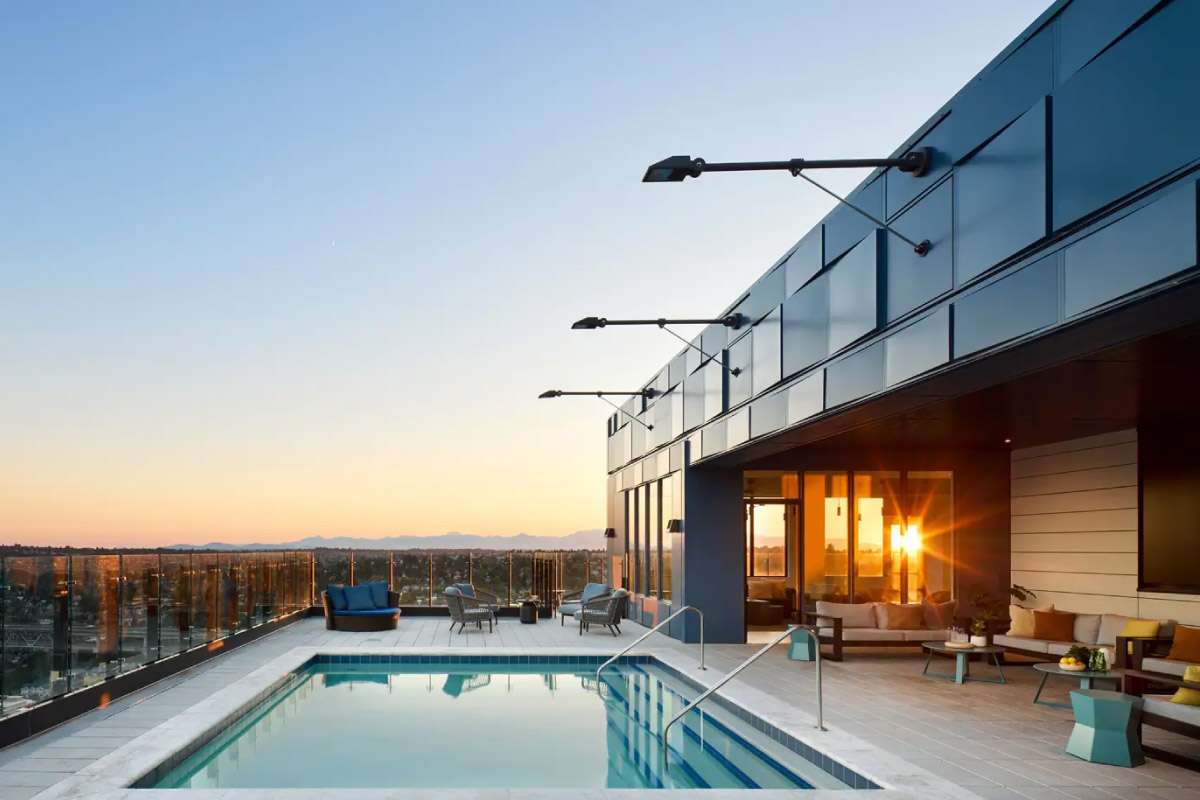
Up Campus Living’s Leo Tallahassee near Florida State University will deliver a 9,500-square-foot rooftop deck with a resort-style pool, hot tub, jumbotron, and cabanas alongside more than 26,000 square feet of indoor amenities including cold plunge, tanning, indoor pickleball, basketball courts, and a golf simulator. Blume on Ivy near the University of Virginia pairs quartz countertops and stainless steel appliances with a private training studio, sauna, and spa. Landmark Properties’ The Standard at West Lafayette for Purdue students features a heated rooftop pool, gaming lounge, and interior courtyard. The Penny on College Main near Texas A&M is offering townhouse-style units with private bathrooms for every bedroom. These aren’t amenity lists padded to fill a brochure. They reflect a development philosophy that recognizes students as consumers who will make active, informed choices about where they live, and who will expect those choices to be worth making.
The evolution goes well beyond what’s offered and extends into how shared spaces are designed to function. The most sophisticated student housing developments being built today are borrowing directly from the best thinking in commercial office design, specifically the idea that great environments don’t just accommodate activity but actively generate the kind of spontaneous interactions and social collisions that define the richest parts of college life.
Subtext’s EVER and VERVE College Station development in Texas A&M’s Northgate district programs its common areas across a spectrum from open social lounges to private collaborative rooms, mirroring the range of work modes that the best corporate campuses have built for. Gilbane’s Zaya near the University of Florida layers three distinct outdoor courtyards alongside interior coworking lounges and study rooms distributed across every floor, creating multiple scales of gathering that allow chance encounters as naturally as focused solitary work. The Standard at West Lafayette uses stacked amenity levels to keep residents moving through the building vertically, rather than concentrating social life in a single destination. The design intention in all of these projects is the same: if you arrange space thoughtfully, community doesn’t need to be programmed. It emerges on its own.
Where the current generation of student housing is breaking genuinely new ground is in how it supports the creative and professional dimensions of student life, not just the social ones. Subtext’s Verve Columbia near the University of South Carolina will include a content creation studio, study pods, and meditation rooms among its Gen Z-focused amenities, a direct acknowledgment that a significant share of today’s students are producing digital content as part of their academic work, their social presence, or the early stages of their professional lives. A properly equipped content studio with acoustic treatment, lighting infrastructure, and equipment access is a fundamentally different offering than a business center with a printer. It reflects the reality of how students are actually using technology and what they need a building to support in 2027 and beyond. The Penny on College Main frames its entire design philosophy around academic success, with its CEO describing every decision as being filtered through the question of how the community can help residents stay in school, and translating that philosophy into study spaces distributed across every residential floor for both individual and group use. Zaya incorporates high-end appliances alongside its co-working infrastructure, treating the domestic and the professional as equally worth designing for.

The maker space concept, long a campus amenity that required a trip to the library or engineering building, is beginning to find its way into the residential environment as well. Innovation Square in Rochester, New York takes this the furthest, positioning direct access to high-tech companies for mentoring and internship programs as a core part of what it means to live there, effectively dissolving the boundary between where a student sleeps and where they develop professionally. That integration reflects a broader shift in how students themselves think about the college experience. The compartmentalization between academic life, social life, and professional development that defined previous generations of student culture has collapsed. Students expect their environment to support all of those dimensions simultaneously, and housing that was designed around artificial separations between them is increasingly out of step with how students actually live.
What the current development pipeline ultimately reveals is that student housing is in the middle of a genuine identity shift. It has shed its reputation as a category defined by tolerance and proximity, and it is becoming something considerably more intentional. The developers breaking ground now are asking questions about the specific person who will live in their building, what that person’s daily life actually looks like, what they need to do the work of being a student well, and what kind of community they want to come home to. Those are harder questions than asking how many beds fit on a floor, and the buildings that emerge from them are harder to build but also harder to replicate. As supply continues to moderate, the student housing developments that will define the next era of the category are the ones being designed right now, and what they are choosing to prioritize says a great deal about where student housing is going.
The post A New Generation of Student Housing Is Raising the Bar on What It Means to Live Near Campus appeared first on Propmodo.