



Why Healthcare Is Having Its Open Office Reckoning
The open-plan office reckoning has been well documented. Over the course of a decade, the commercial real estate and workplace design industries accumulated substantial evidence that stripping away private space in the name of collaboration and cost efficiency had created environments that were too loud, too distracting, and too poorly suited to focused or confidential work. The response has been a gradual but meaningful shift in how offices are designed. More acoustic zoning, more access to enclosed space, and the widespread adoption of privacy pods and phone booths that give workers a quick retreat without requiring a trip to a conference room. That conversation has been largely confined to the commercial office world. It is now beginning to happen in healthcare, where the noise problem is older, better documented, and considerably more consequential.
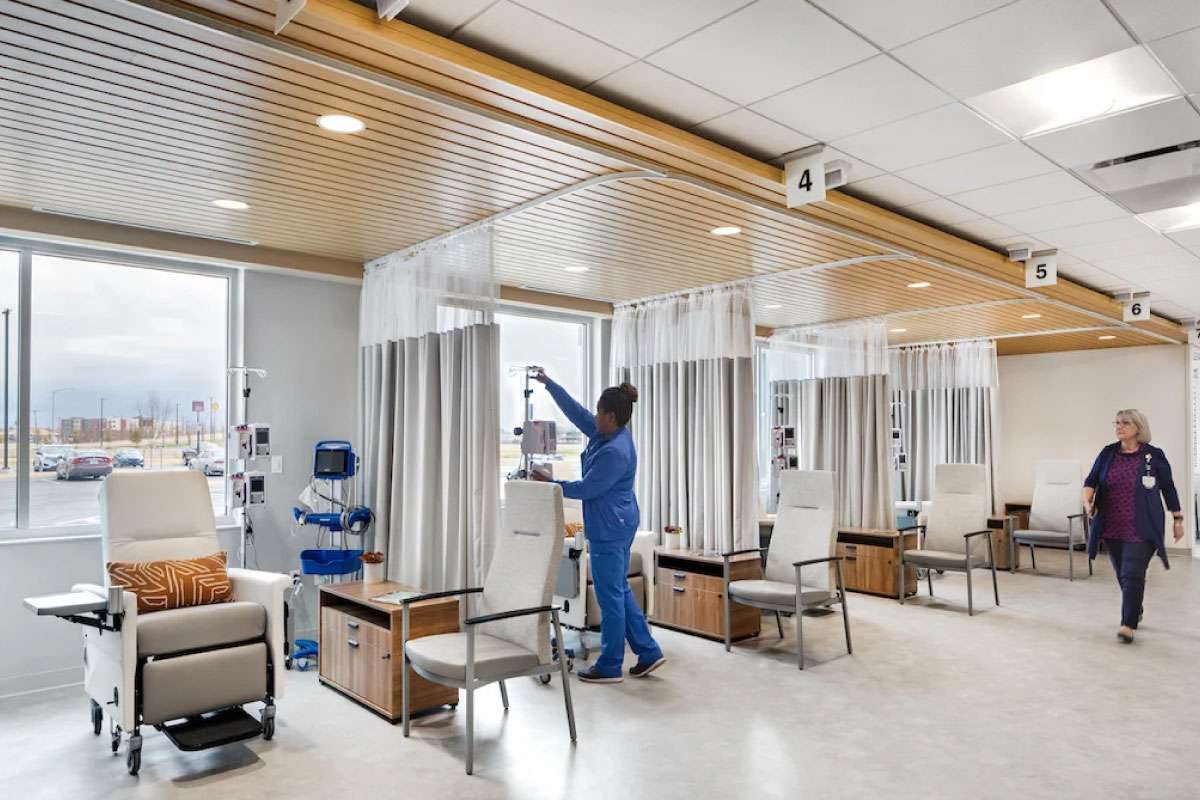
“Open-plan offices and modern healthcare facilities share more than most people realize,” said Elyse Heckman, SVP of Brand at ROOM. “Both have traded private space for operational efficiency, and both are paying the price in worker well-being. The difference is that in healthcare, the consequences are impossible to ignore.” Modern hospital design has long prioritized operational flow, infection control, and patient throughput over acoustic comfort. The results are clinical environments that are persistently and measurably loud. “Healthcare environments are chronically loud, averaging 50 to 70 decibels when guidelines recommend no more than 40,” Heckman noted. “That creates real consequences: patients withhold sensitive information, caregivers experience heightened stress, and HIPAA compliance is compromised.” A nurse delivering a diagnosis in a busy corridor or a physician taking a sensitive call at a shared workstation isn’t just dealing with an uncomfortable acoustic environment. They are operating in conditions that can directly affect patient privacy, clinical accuracy, and regulatory compliance.
The caregiver side of the equation is where the urgency is becoming most acute. Healthcare has been in the grip of a workforce crisis that predates the pandemic and has worsened significantly since. The U.S. healthcare sector is projected to face a shortage of up to 3.2 million workers by 2026, with burnout and poor working conditions cited as primary drivers of turnover across nursing and allied health professions.Average hospital turnover rates reached 22.7% in 2023, with registered nurse turnover sitting at 18.4%, meaning nearly one in five nurses left their position within a single year. The cost of turnover for a single bedside registered nurse is estimated at between $40,000 and $60,000, placing the average hospital’s annual nursing turnover cost at several million dollars. Burnout is driving a significant share of those departures. More than 50% of nurses reported experiencing burnout symptoms in 2024, with excessive workload, lack of autonomy, and poor work environment consistently ranking among the top contributing factors.
“One of the biggest healthcare trends right now is the shift from designing strictly for patients to designing for the people who care for them, too,” said Stan Gray, VP of Healthcare at Carolina. “As caregiver shortages, burnout, and turnover continue to rise, healthcare organizations are rethinking environments through the lens of staff well-being, retention, and resilience.” The physical environment is a more significant variable in that equation than most administrators have historically recognized. Studies have found that nurses working in high-noise environments report significantly higher rates of cognitive fatigue, emotional exhaustion, and intention to leave their positions. Research published in the Journal of Nursing Administration found that noise was among the top environmental stressors cited by nurses, with exposure to sustained high-decibel environments correlating with measurably higher burnout scores independent of workload factors. The physical environment, long treated as a fixed constraint in workforce discussions, is beginning to be understood as something organizations can actually change, and the connection between acoustic conditions and staff retention is becoming part of that conversation at the leadership level.
The challenge has been that solutions developed for the office world don’t transfer cleanly to healthcare settings. Privacy pods became ubiquitous in offices and coworking spaces precisely because they offered a flexible, relatively low-cost way to add enclosed private space without major construction. But the same products that work well in a law firm or a tech company are poorly suited to a clinical environment. ROOM and Carolina have collaborated on a line of privacy solutions designed specifically for healthcare environments, with ventilation systems engineered to meet clinical standards and surface materials selected to withstand infection-control requirements. “Privacy pods have long been a staple of offices and coworking spaces,” Heckman said, “but no version could withstand the demands of a clinical environment.” The specific barriers are ventilation systems that meet healthcare codes and surfaces that can survive hospital-grade cleaning and infection-control protocols.
“Instead of relying solely on enclosed offices, conference rooms, or staff lounges, hospitals can now embed smaller moments of privacy, focus, and restoration directly into the care environment,” Gray said. “That changes both how space is planned and how it functions day to day.” When acoustic privacy is a fixed architectural feature, it only exists where the original design put it, and adding more requires construction. When it can be deployed as a modular element anywhere on the floor plate, planners gain flexibility that changes how they think about the relationship between layout and function entirely.
The broader trajectory points toward a healthcare design practice that borrows more deliberately from the acoustic planning discipline that commercial office design has been developing for years. The office world’s experience produced a useful set of frameworks. Sound masking systems, zoned acoustic environments, material specifications for noise absorption, and protocols for balancing open areas with enclosed private ones all translate with relatively minor adaptation to clinical settings. Healthcare architects and facility managers are increasingly aware of this body of work, and the willingness to apply it is growing as the evidence connecting noise to both patient outcomes and caregiver well-being becomes harder to ignore. The Center for Health Design has documented that noise reduction interventions in hospital environments correlate with measurable improvements in patient satisfaction scores, reduced medication errors, and lower staff turnover rates. One study found that implementing targeted acoustic interventions in a hospital unit reduced staff-reported stress levels by 28% and contributed to a measurable improvement in intent-to-stay scores among nursing staff within six months of implementation. That gives facility investment in acoustic quality a financial return that administrators can explain in terms their boards understand.
What the healthcare industry is working through is a version of the same realization the office world reached several years ago. The physical environment is not a neutral backdrop to the work happening inside it. It shapes the quality of that work and the well-being of the people doing it. In healthcare more than anywhere else, it also shapes the outcomes experienced by the people being served. The solutions that commercial real estate and workplace design have spent a decade refining are not a perfect fit for clinical environments, but they are a meaningful starting point. Hospitals that begin approaching acoustic design with the same intentionality as the best office buildings will find that quieter environments aren’t just more pleasant. They are measurably better places to deliver care, and measurably better places to keep the people who provide it.
The post Why Healthcare Is Having Its Open Office Reckoning appeared first on Propmodo.